
All About Accuracy…
Paint color match accuracy is commonly measured in units called “dE” or “deltaE”, as defined by International Commission on Illumination (CIE).
Different dE values correspond to different levels of human perception of the color difference, where lower means a better match:
dE < 1.0: Virtually indistinguishable to the human eye.
dE = 2.0: Barely distinguishable for an untrained eye.
dE = 2.5: Considered acceptable for most commercial printing.
dE = 5.0: A very noticeable color difference.
When used according to the simple instructions, FindPaintColor usually provides a measurement accuracy of dE less than 2.5, and almost always less than 3.0.
Here is an example of how these dE’s look visually, in this case for a wall color of ‘Damask Rose’ and three similar colors, as found by FindPaintColor :
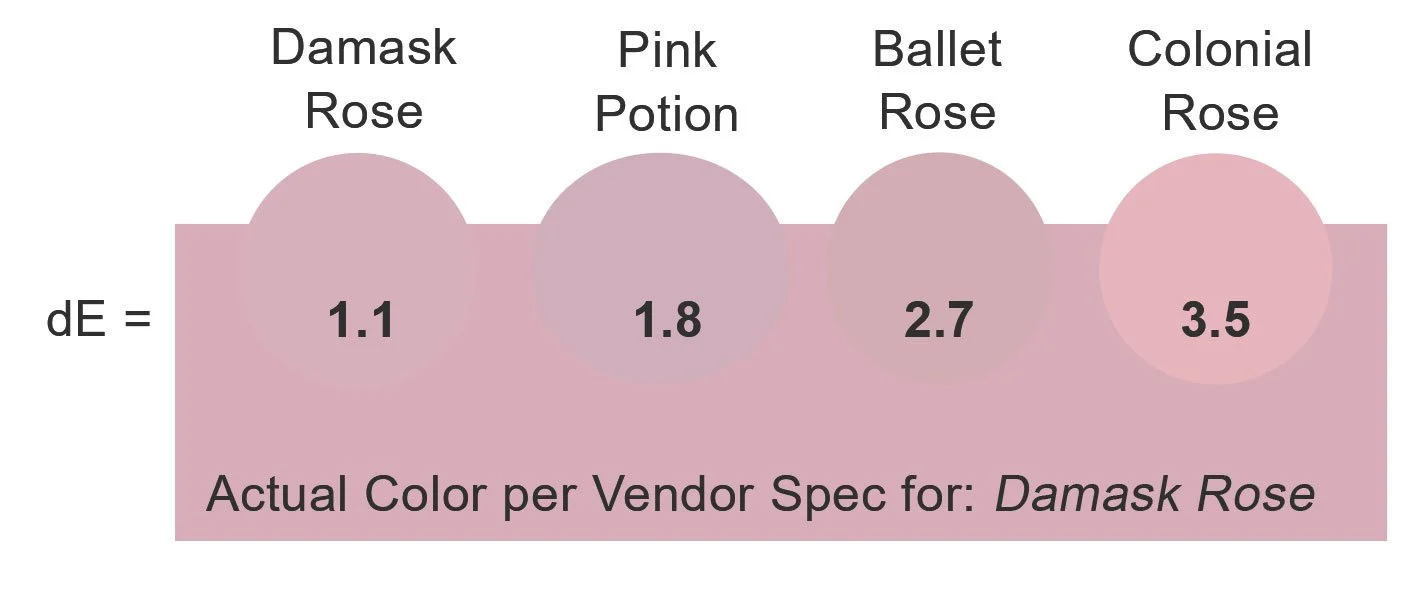
For touch-up painting, a dE of < 2.5 can be considered not noticeable, especially if the touch up is ‘feathered’ at the edges with a feather brush. A dE of < 2.5 is also usually acceptable for re-painting only one wall of a room, where the lighting is different from adjacent walls. (In this typical example, FindPaintColor shows an overall accuracy of dE = 1.1.)
For comparison of the accuracy of different color match methods, the following compares typical accuracy test results of FindPaintColor, with two ‘color capture’ apps from major paint vendors that work from normal photos (so, without the use of a reference white chip, and without FindPaintColor’s advanced processing):
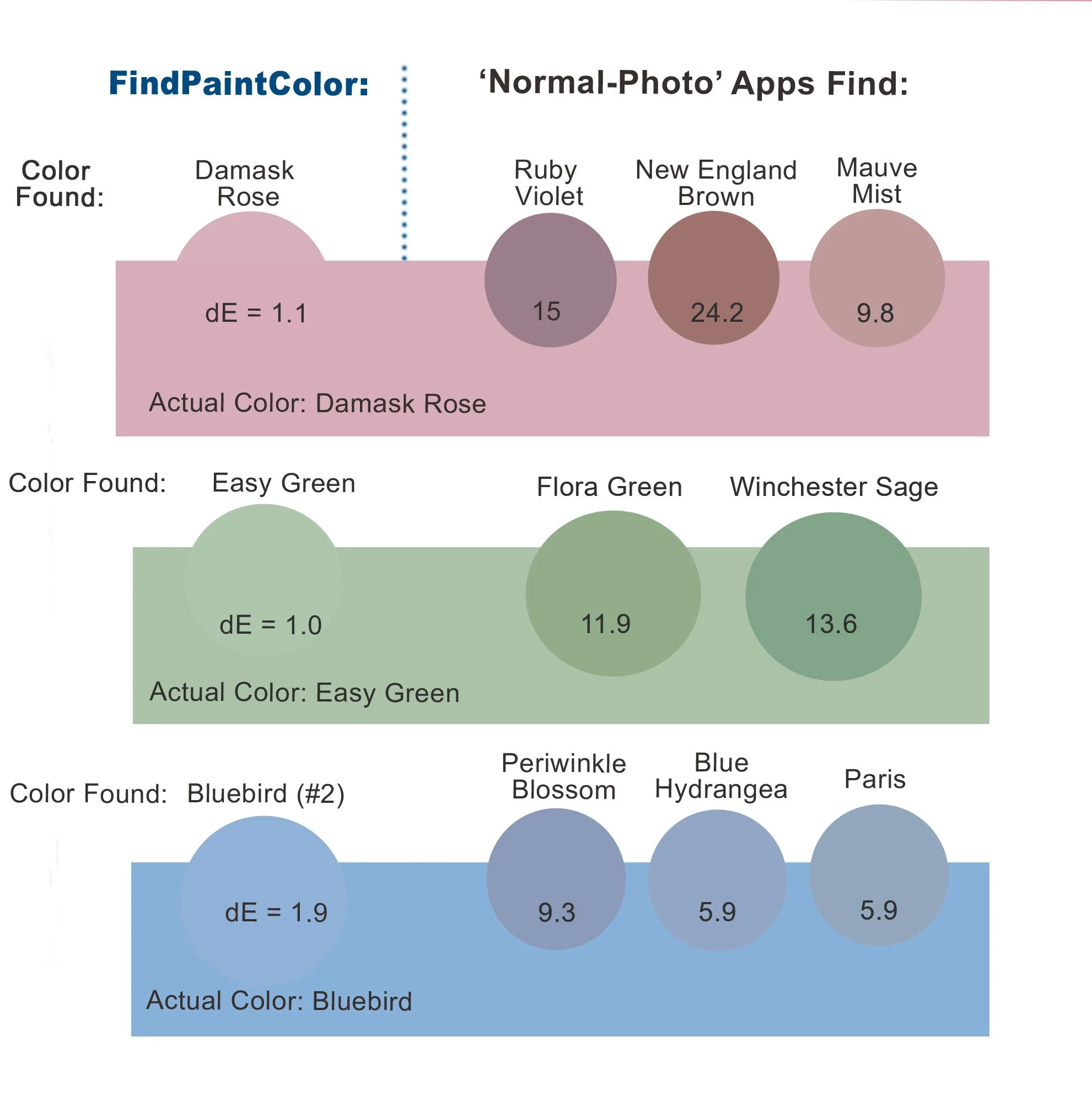
These examples show how FindPaintColor app provides suitable accuracy for touch up, or when painting walls corner to corner, with dE’s as shown in the range of 1.0 to 1.9. In a wide range of testing, FindPaintColor usually provides accuracy of dE below 2.5.
It also shows that apps from major paint vendors that simply use normal photos, with the test results as shown at the right in the above figure, are not suitable for this purpose, having dE’s of 5.9 to 24, way worse the required 2.5 or so.
A final note: Although FindPaintColor provides accurate results, it is best to follow the ‘measure twice, cut once’ rule, and take two or more readings and ensure they are similar. And, if extra certainty is desired, pre-compare the selected best match color visually with a color chip.